
Quantum Map: Navigating the High Seas with Different Perspectives
Why AI Might Safe Quantum: About Unusual Thinking (+ Post SPAC SEC Files)

0. Preface
I firmly believe, that the best early tech investment cases can just directly picked up from developer blogs, GitHub repos and similar sources. We just need to know where to look. Early adoption of new technology needs to pass the assessment from real experts in the relevant topics. Let’s be honest: 99% of investors can’t judge a new technology from the outside. We need to think like an expert and adopt their behaviours. New tech needs not just to work, it needs to gain excitement from other experts by the network effect. If we can listen to those unfiltered opinions and combine it with a financial risk assessment, we got good chances to find a good investment. Of course at a reasonable price.
The quantum world is currently evolving very quickly. This article is very comprehensive (10.000 words) and provides a good introduction to the quantum world. While writing this article, I realised how hard it really is, to cover an already extremely complex topic/technology, also from different angles of view. It’s like navigating the high seas with multiple compass needles. I tried my best. If you miss something, just text me.

When the topic becomes popular, we want to have a good overview. I plan to provide regular updates if adjustments to the investment strategy are necessary due to technical progress.
Grab a cup of ☕️ and enjoy reading.
1. The Endless Quantum Breakthrough
“Quantum Supremacy” is a term that was coined in 2012 by John Preskill, Richard P. Feynman Professor of Theoretical Physics at the California Institute of Technology (Caltech). It refers to the demonstration of quantum computation that solves a problem that cannot be solved classically in any realistic timeframe.
Let’s do a simple explanation what are physical and logical qubits:
During the execution of algorithms, errors among the noisy physical qubits will be automatically detected and corrected. Therefore, whereas individual physical qubits are too noisy to be useful, with a logical qubit quantum computing will become practical.
The commonly given ratio is that each logical qubit requires approx. 1,000 physical qubits on standard models like “Surface Code”. However, an article from Everything Explained Today titled “Physical and Logical Qubits Explained” notes that topological qubits may require as few as one physical qubit per logical qubit.
However, the 'Surface Code' orthodoxy is actively being destroyed right now. Just recently, a massive demonstration by Quantinuum, part of HON 0.00%↑ Honeywell International, utilizing Iceberg Quantum's high-rate qLDPC codes proved we don't need a 1,000:1 ratio. They demonstrated high-rate qLDPC codes achieving up to 8 fully error-corrected logical qubits from 98 physical in the published example (with further scaling progress reported). This ‘beyond break-even’ milestone proves that smart error correction on the right hardware can dramatically reduce overhead. They achieved a logical 2-qubit gate fidelity of 99.99% and dropped the logical memory error to <4 times 10^-5 per qubit per cycle. This "beyond break-even" milestone proves that smart error correction on the right hardware can bypass the need for millions of physical qubits.
Topological qubits are still theoretical. Among existing modalities, neutral atoms are among the highest quality. We will dig deeper on the different variants of qubits, like Superconducting Qubits, Trapped Ion Qubits, Photonic Qubits, Neutral Atom Qubits, Spin Qubits and some more in the next chapters. Each of them has specific behavior patterns.
What I want to say in easy sentences: Even for somebody who studied computer science, it’s not easy to explain this very complex topic. When Google Quantum AI launched Willow, their state-of-the-art quantum chip in 2024/2025, Hartmut Neven, Founder and Lead, Google Quantum AI, did the math, that quantum optimized calculations on Willow took 5 minutes, also performed on Frontier HPC, the fastest Supercomputer 2 years ago, would have taken 10 septillion years. That’s a number with many zeros: 10,000,000,000,000,000,000,000,000 years, which is older that the universe itself. This allowed Hartmut Neven entry for a statement, that quantum computing occurs in many parallel universes🤯, in line with the idea that we live in a multiverse, a prediction first made by David Deutsch. If you got some time, order the book. It’s mind blowing. In some areas, it’s also available on Spotify.
With that having said, the pressure of expectations on this article is high. We all know the statement: Quantum computing is a decade away. Always for decades. But maybe we get closer now. Reliable and concrete approaches are in close sight.
But why did I claim to get closer to useful quantum scenarios. Of course, it’s the roadmaps of the vendors. But the strongest sign comes clearly from NVDA 0.00%↑ itself. The undisputed AI king.
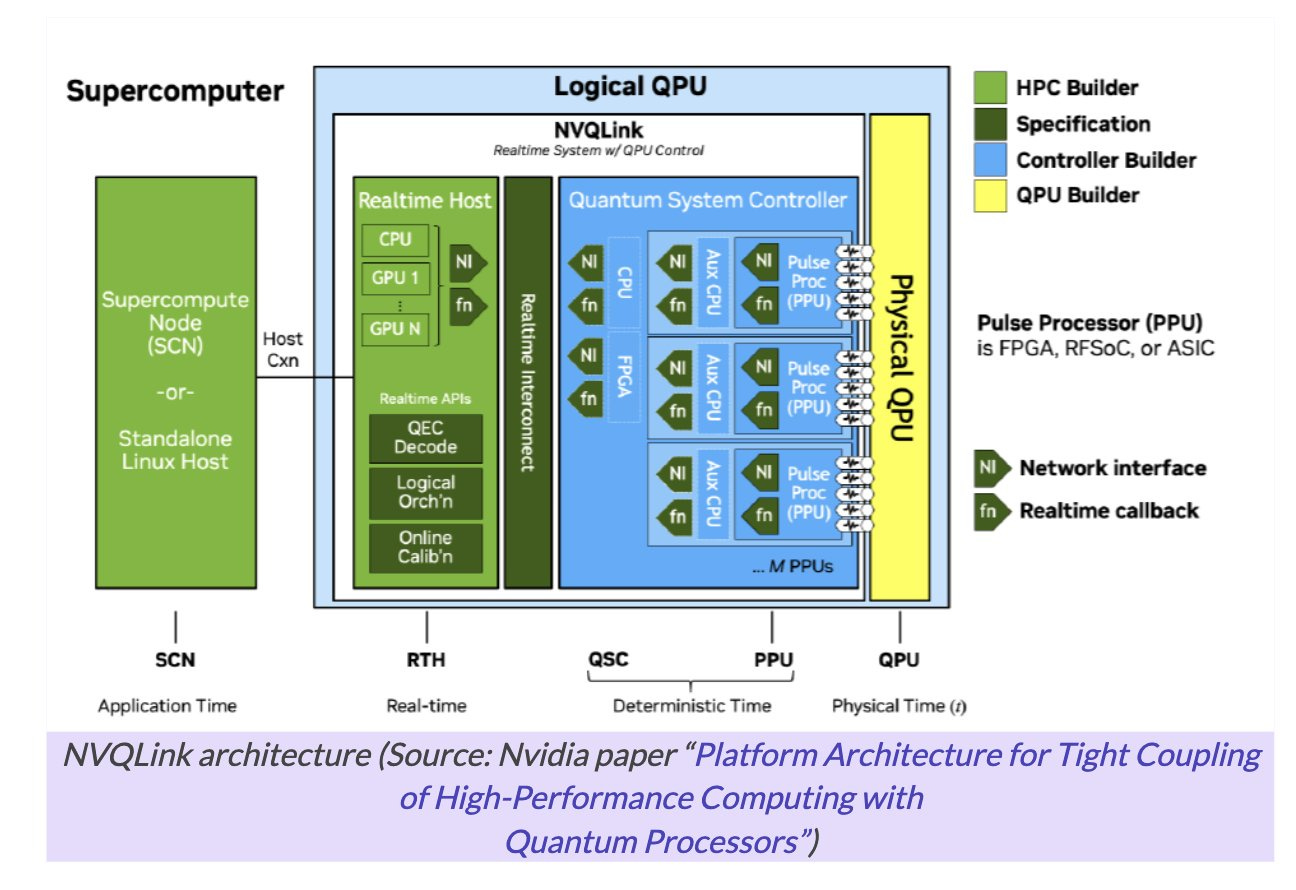
Source: The NVQLink architecture introduces GPU acceleration to the QPU environment
The NVQLink Architecture:
NVIDIA NVQLink functions as a high bandwidth, low latency bridge designed to move quantum classical hybrid computing from the PCIe bottleneck into a unified memory coherent ecosystem. At its core, the technology utilizes a physical layer (in yellow) based on NVIDIA’s established NVLink high speed interconnect, repurposing the signaling protocols to facilitate direct communication between a Tensor Core GPU and a Quantum Processing Unit (QPU) controller. Unlike traditional async communication over a system bus, NVQLink enables a heterogeneous computing fabric where the GPU and QPU can operate on a shared execution timeline with nanosecond level sync. It transforms the QPU from a slow peripheral into a high speed unit within the NVLink fabric.
The data movement is handled by specialized hardware engines that manage the conversion between the GPU’s massive parallel execution threads and the QPU’s control sequences. This architecture minimizes “tail latency” during iterative algorithms like the Variational Quantum Eigensolver (VQE) or Quantum Approximate Optimization Algorithm (QAOA), where the GPU must rapidly process measurement data from the QPU to calculate the next set of quantum gate parameters. By integrating the QPU into the NVLink network, the system treats the quantum processor as an accelerated peer rather than a remote peripheral (which would be very slow). This tight coupling allows for real time feedback loops where the GPU’s massive throughput is used for error mitigation and state decoding at speeds that keep pace with the QPU’s coherence times. The software layer is orchestrated via NVIDIA CUDA-Q, which abstracts the hardware level NVQLink transactions into a programming model, ensuring that the memory sync and instruction scheduling are handled by the compiler and runtime rather than manually by the developer.
Does it work? Yes.
NVQLink is already being adopted by leaders in the quantum computing ecosystem. QPU builder Quantinuum announced that their future processors will deploy using NVQLink, and their recently announced Helios QPU is deployed with an NVIDIA GH200 Grace Hopper as real-time host. The GH200 server is used for real-time quantum error correction with syndrome decoders from the CUDA-Q QEC library.
The CUDA-Q nv-qldpc-decoder can exploit the all-to-all connectivity of Helios, enabling research into quantum low-density parity check (qLDPC) codes. This shows promise in lowering the overheads of fault-tolerant quantum computing. Helios is a machine capable of running any qLDPC code, and the NVIDIA decoder can decode any qLDPC code for Helios in real time.
The NVIDIA team collaborated with Quantinuum to demonstrate this capability. We decoded a high-rate qLDPC code called Bring’s code, which encodes eight logical qubits into 30 physical qubits. The decoding algorithm for this experiment was BP+OSD (belief propagation plus ordered statistics decoding), which ran with a 67 microsecond median decoding time, enabling error correction with feed-forward corrections in real time.
We used this to build an 8-logical-qubit logical memory. After running three rounds of quantum error correction on Helios, the eight logical qubits exhibited a 0.925±0.38% error rate, a 5.4x improvement over the 4.95±0.67% prior to decoding.
This very early success shows the potential of NVQLink to accelerate the emergence of fault tolerant quantum computing.
Why does it matter? It’s like a very fast “spell check” for a quantum computer that is finally fast enough to fix mistakes before they ruin the entire calculation. Nvidia is positioning itself in the middle of the spider web. Nvidia controls the ecosystem and (almost the whole) stack. One delicate missing pice of puzzle will be topic in later chapters.
Quantum computers are incredibly powerful but also extremely prone to errors. They make mistakes almost constantly because they are sensitive to heat and their environment. To get reliable answers, the computer needs to catch these mistakes and fix them in a split of a second.
Normally, the “brain” that does the fixing (the GPU) is too far away from the quantum heart (the QPU). By the time the fix is sent back, the quantum computer has already crashed.
The NVQLink Solution acts like a special high speed fiber optic line between the two. It allows the GPU to see a mistake, calculate the fix, and send it back in microseconds.
In NVIDIA’s test with Quantinuum, they took a group of 8 messy quantum bits and used this high speed link to make them 5 times more accurate.
Sounds good. Very elegant solution. And NVIDIA showed multiple times, that they offer reliable and proven software solutions. From Gaming/GPU to Bitcoin Mining to AI and most likely with CUDA-Q and NVQLink they will be THE quantum booster.
Nvidia built the highway. Now, who has the best car to drive on it?
